
The Evolution from Chatbots to Autonomous Agents
The initial wave of generative artificial intelligence focused on conversational interfaces. Users typed text into a window, and the model returned text in return. The model was an observer: it could analyze, summarize, and advise, but it possessed no hands. It could not change the world outside its dialogue box.
The industry is now undergoing an architectural transition from passive conversationalists to active, goal-oriented AI agents. An agent is a language model embedded inside a persistent software loop, equipped with external tools, short-term and long-term memory systems, and the authority to take concrete actions on behalf of a user.
An agent does not merely explain how to cancel a hotel reservation; it connects to the reservation database, confirms your cancellation policy, issues the cancellation command, and emails you the confirmation number.
However, granting an autonomous probabilistic model access to real-world software systems introduces immense operational danger. If unconstrained, agents enter infinite recursive loops, execute hallucinated commands, and fail silently. Moving from an experimental demo to a robust enterprise agent requires disciplined systems engineering.
The Core Loop: The ReAct Pattern
At the foundation of nearly every production agent lies a conceptual framework known as the ReAct pattern—an acronym for Reason, Act, and Observe.
┌───────────────────────────────┐
▼ │
[User Objective] ──► [Reasoning Phase] ─┼──► [Action Execution]
▲ │ │
│ ▼ ▼
└─── [Observation] ◄─────┘
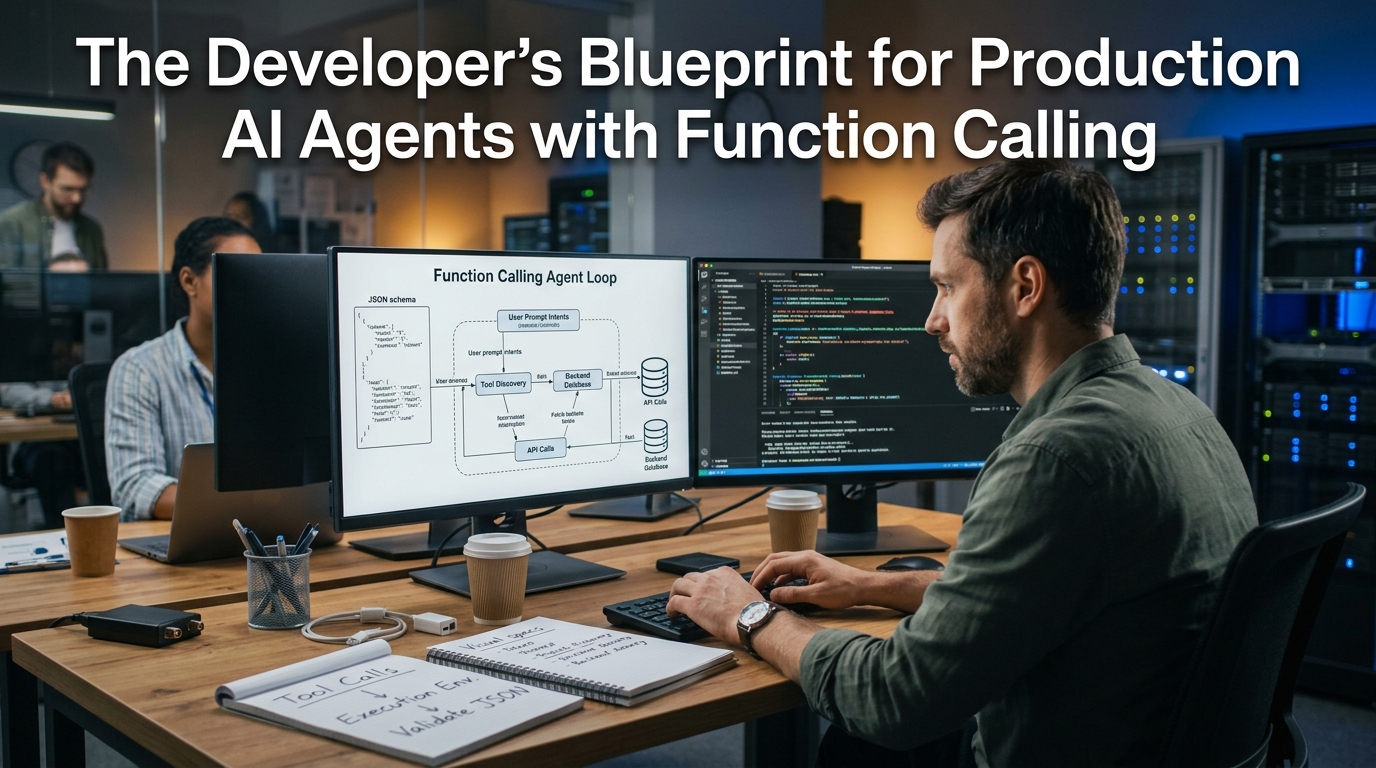
Rather than attempting to resolve a multi-tier goal in a single generation step, the agent navigates an iterative cycle:
- Reasoning: The model reviews the overarching user objective, inspects its current environment, and generates an internal hypothesis regarding the single next step required.
- Action: The model emits a structured tool request—such as querying a customer database, reading a document, or pinging an external API.
- Observation: The host software environment executes the requested tool and feeds the raw objective results back into the model’s active context window.
- Evaluation: The model reads the observation. If the objective remains incomplete, the loop restarts, with the new observation informing the next reasoning step. If the objective is met, the loop terminates and delivers the final report.
This loop provides resilience. If a specific tool invocation fails or returns an unexpected error, the agent does not immediately crash. It observes the error message, reasons about the cause of the failure, and attempts an alternative method to achieve the goal.
The Critical Role of Structured Tool Interfaces
Early attempts at building agents relied on unstructured natural language prompts to drive tools: “If you want to search, write SEARCH: query.” This proved exceptionally fragile. Models would frequently misspell the command, omit vital parameters, or wrap the instructions in conversational politeness.
Production architectures rely exclusively on structured function schemas. The developer provides the language model with an exhaustive, unambiguous contract defining available capabilities:
- The precise name of the operation.
- A comprehensive plain-English description explaining exactly when and why the tool should be selected.
- A strict structural definition detailing required parameters, acceptable data formats, and mandatory boundaries.
When the model decides to act, it does not output conversational prose; it emits a strictly validated data payload that can be parsed and executed safely by your core application infrastructure.
The Trap of Pure Autonomy: Why State Machines Matter
The most common mistake teams make when deploying agents is granting the model total structural freedom. They provide an LLM with fifteen diverse tools, prompt it with “Accomplish this business goal,” and let the autonomous loop spin freely.
This pure-autonomy design pattern fails in production environments because it lacks determinism. An agent given total freedom will inevitably invent creative, unintended routes to achieve goals, skipping mandatory compliance checks, running redundant expensive queries, or getting stuck in cyclical analytical traps.
Reliable agents are rarely pure, unconstrained free agents. Instead, they are built as Deterministic State Machines guided by an LLM engine.
In a hybrid state-machine architecture, the overall sequence of operations is strictly governed by traditional software code:
- The agent can only transition between pre-authorized phases (e.g., Discovery ➔ Verification ➔ Approval ➔ Execution).
- The language model provides the dynamic intelligence within each phase, interpreting noisy data, synthesizing summaries, and deciding between a tightly controlled subset of context-appropriate tools.
- Transitioning to a destructive or permanent action—such as transferring funds, wiping records, or sending external communications—triggers an immutable system boundary requiring human-in-the-loop authorization.
Designing Resilient Safety Guardrails
Building for production means designing for graceful failure. An agent pipeline must incorporate non-negotiable operational circuits:
- Maximum Step Limits: Every agent loop must operate under an absolute execution ceiling. If an agent fails to achieve its objective within eight or ten operational cycles, the loop must terminate automatically, alerting an operator rather than consuming compute indefinitely.
- Strict Parameter Verification: Never allow an agent’s tool call to execute against raw production databases without a distinct software validation layer standing between them. Ensure that data types, permissions, and ranges are programmatically enforced by traditional code before any system write operation takes place.
- Context Hygiene: In long, multi-step agent investigations, the active context window fills rapidly with raw tool outputs, system errors, and verbose payloads. Implement regular pruning routines that summarize past actions into concise factual logs, keeping the agent’s attention focused squarely on its remaining milestones.
True artificial intelligence agents are not science fiction novelties. When built with structured execution schemas, deterministic behavioral boundaries, and robust safety guardrails, they transform from brittle toys into the most powerful automation engines in modern enterprise software.
