RAG is Not Enough: Building Resilient Agentic Retrieval Architectures
The Allure and Failure of Naive Retrieval
Retrieval-Augmented Generation, universally abbreviated as RAG, was celebrated as the ultimate remedy for the core weaknesses of large language models. The premise was straightforward: rather than retraining or fine-tuning massive models to impart new facts, you connect the model to an external library of documents.
In a basic or “naive” RAG configuration:
- You break internal knowledge documents into uniform chunks of text.
- You convert those chunks into mathematical vectors and store them inside a vector database.
- When a user asks a question, you convert their inquiry into a vector, calculate cosine similarity against your stored documents, retrieve the five closest matches, and pass them into the prompt as background context.
In controlled pilot demos, naive RAG appears magical. In real-world enterprise deployments, it frequently shatters.
Real business documents are not composed of neat, independent paragraphs containing single facts. They contain sweeping cross-references, nested definitions, dense tables, footnotes, and shifting chronological updates. When a naive system blind-matches mathematical similarity, it often retrieves irrelevant text that merely shares vocabulary with the user’s question, while completely missing the deeper conceptual truth.
Why Vector Similarity Deceives
The fundamental vulnerability of basic RAG is its over-reliance on semantic vector similarity. Vector math excels at identifying broad thematic relationships. If you search for “automobile maintenance,” a vector database effortlessly retrieves documents containing “car engine repairs” because the concepts reside in nearby spatial coordinates.
However, business inquiries frequently require precision rather than broad thematic alignment. Consider a user searching an internal compliance portal: “What were our approved data retention policies for European customer records between 2021 and 2023?”
A basic vector search will return dozens of chunks discussing “data retention,” “policies,” and “European regulations.” Yet it may completely miss the critical update memo from 2022 that amended the policy, simply because that memo used slightly different phrasing. The search system delivers high semantic relevance paired with disastrous factual inaccuracy.
User Query: Specific Policy Exception (2022)
│
├──► Naive Vector Match: Broad Corporate Guidelines (Irrelevant)
│
└──► Agentic Retrieval: Temporal Check ──► Target Memo Located
The Three Pillars of Agentic Retrieval
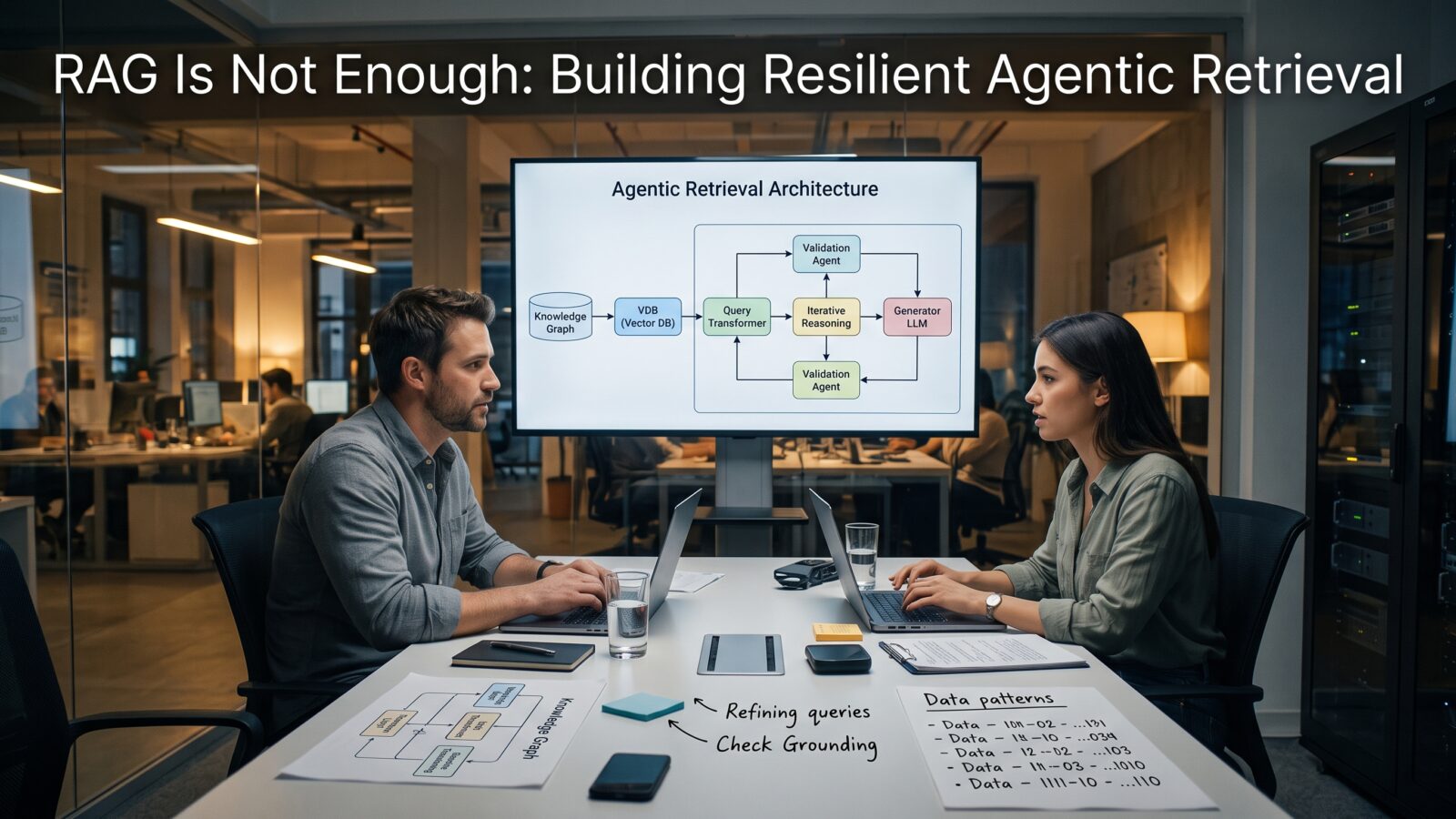
To rescue retrieval systems from this trap, architects are moving toward Agentic Retrieval architectures. Unlike static pipelines that blindly retrieve text once and immediately generate an answer, an agentic system treats information gathering as an iterative, self-correcting research loop.
1. Query Decomposition and Hypothetical Expansion
Users rarely ask search-optimized questions. They ask ambiguous, multi-part questions that conflate several distinct inquiries into one sentence.
An agentic retrieval architecture inserts an intelligent pre-processing step before touching the database. The system inspects the user’s prompt and decomposes it into multiple targeted search queries.
Furthermore, the system can utilize Hypothetical Document Embeddings. Instead of searching the database with the user’s short question, the model first generates an imagined, ideal paragraph answering that question. The system then searches the vector database using that hypothetical answer. Searching for an answer against an answer yields far higher mathematical precision than searching for an answer using a question.
2. Hybrid Search and Reciprocal Rank Fusion
Relying entirely on vector search throws away decades of battle-tested information retrieval science. Modern enterprise retrieval requires hybrid pipelines that run two parallel searches simultaneously:
- Dense Semantic Search: Capturing broad contextual intent and natural language synonyms via vector databases.
- Sparse Lexical Search: Capturing exact keyword matches, serial numbers, specific product codes, and precise legal names via traditional BM25 search indices.
The results of these two divergent searches are then merged using Reciprocal Rank Fusion algorithms, ensuring that documents containing exact key identifiers are elevated alongside conceptually relevant passages.
3. Cross-Encoder Reranking
Standard embedding models convert entire paragraphs into a single compressed vector coordinate. During this compression, granular nuances are inevitable lost.
An agentic pipeline introduces a specialized, computationally focused reranking model directly after the initial retrieval stage. If the hybrid search retrieves the top fifty document candidates, the reranker evaluates the full, uncompressed text of each document directly against the user’s exact inquiry. It scores each passage for direct utility, filtering out false positives and reducing the fifty raw candidates down to the five most authoritative, noise-free paragraphs.
Corrective Feedback Loops and Self-Reflection
The definitive hallmark of an agentic system is its capacity to pause and reflect on its own progress. In a naive system, if the retrieved context is useless, the model hallucinates an answer anyway. In an agentic architecture, a validation agent inspects the retrieved text before passing it to the final writer:
- Does this context actually contain the specific facts required to answer the query?
- Are the sources contradictory or chronologically outdated?
- Is there an information gap that requires a secondary, targeted search?
If the retrieved evidence fails this grounding check, the agent rejects the context, adjusts its search terms, and queries alternative data sources automatically.
RAG is not an off-the-shelf feature you turn on; it is an analytical process. By shifting from brittle, one-shot vector lookups to active, self-correcting retrieval architectures, organizations can build knowledge systems that withstand the complexities of real-world enterprise operations.
